Introduction
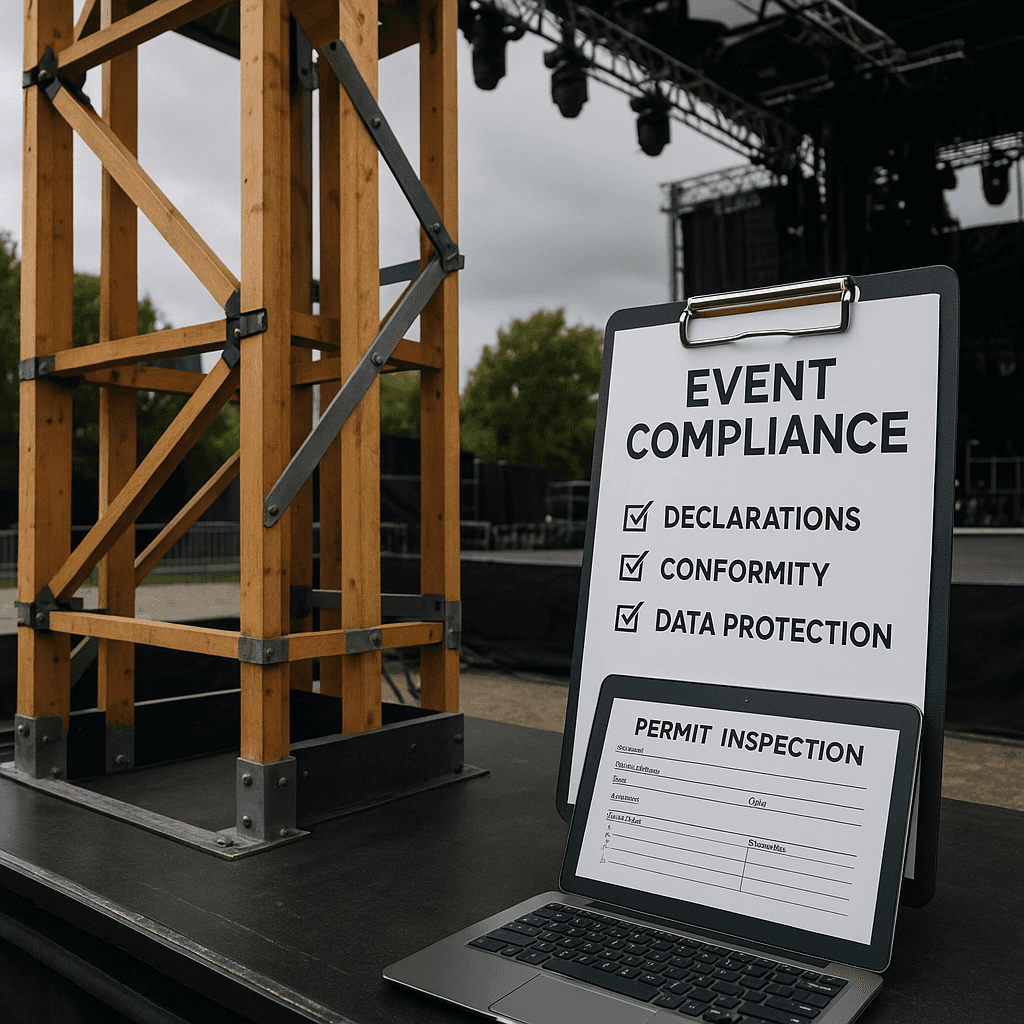
For an event technical structure, legal and administrative compliance is a pillar: declaration formalities, insurance, compliance with safety standards, data protection, social obligations. Neglecting these aspects exposes one to sanctions and calls into question operational reliability.
1. Declarations and Administrative Authorizations
When an event gathers the public or modifies a location, a security notice or a technical file must be submitted to the town hall or the prefecture depending on the type of event.
Example: for events outside of ERP, the organizer must provide: staff, exits, technical installations, emergency means.
The Internal Security Code provides for large events procedures for access, administrative inquiry, and prior control.
It is imperative to verify whether the location is an ERP (establishment receiving the public) and to apply the corresponding rules.
2. Contracts, Insurance, Compliance of Providers
The organization must formalize a service contract with each supplier, specifying responsibilities, intervention conditions, and deadlines.
Ensure coverage by public liability insurance for the organizer, the suppliers, and the equipment.
Verify the qualification and accreditation of security agents, technical providers: e.g., agents must hold a professional card.
3. Data Protection and HR Aspects
If you collect personal data (registrations, ticketing, technicians), you must comply with the General Data Protection Regulation (GDPR): clear information, consent, retention period, security.
For technicians and participants, ensure compliance with employment contracts, work permits, safety conditions, and adherence to applicable standards in your professions. For example: the collective agreement covers technical service providers for events.
4. Recommended Processes
Step 1: initial audit of obligations: location, public, equipment, providers, data.
Step 2: formalization: declaration file, service contract, insurance policy, subcontracting agreements, GDPR.
Step 3: implementation: document tracking, field verification (agents, emergency exits, flow).
Step 4: post-event review: control of discrepancies, incidents, updating documentation.
5. Challenges and Benefits
Reduction of legal, financial, and reputational risks.
Assurance of a rigorous framework to manage operations.
Creation of a standardized documentation base to industrialize interventions.
Better traceability and management of skills and responsibilities.
Conclusion
For your national event technical network, ensuring legal and administrative security is not a "burden" but a lever for professionalization: anticipating obligations, structuring processes, and integrating compliance into management allows for reliable and controlled execution.